Business Consulting – Ayurveda Integrative
Ayurveda in Acute Psychiatry—Rethinking the Way We Heal
Insights from the Diakonie Hospital in Zschadraß
It began with a simple question: What if we brought Ayurveda into an area where it has rarely been considered before—acute psychiatric care?
Zschadraß, a centre with a long tradition of psychiatric care, became the place where this idea was not only explored, but put into practice. This marked the beginning of a project that was far more than an experiment: it became a model for a new dimension of psychiatric treatment.
The Beginning: Between Vision and Reality
Psychiatric hospitals are highly complex systems operating under enormous pressure. Time constraints, staff shortages and severe clinical conditions leave little room for innovation. This made the challenge even greater: Ayurveda had to be introduced not as an additional burden, but as a meaningful form of support that could also relieve pressure on the existing system.
My approach was clear:
Ayurveda should not compete with conventional medicine, but complement it. It should not lecture, but enrich. Above all, it should offer additional support in areas such as side effects, recovery and the restoration of inner balance.
Where We Are Today: The First Stages of Integration
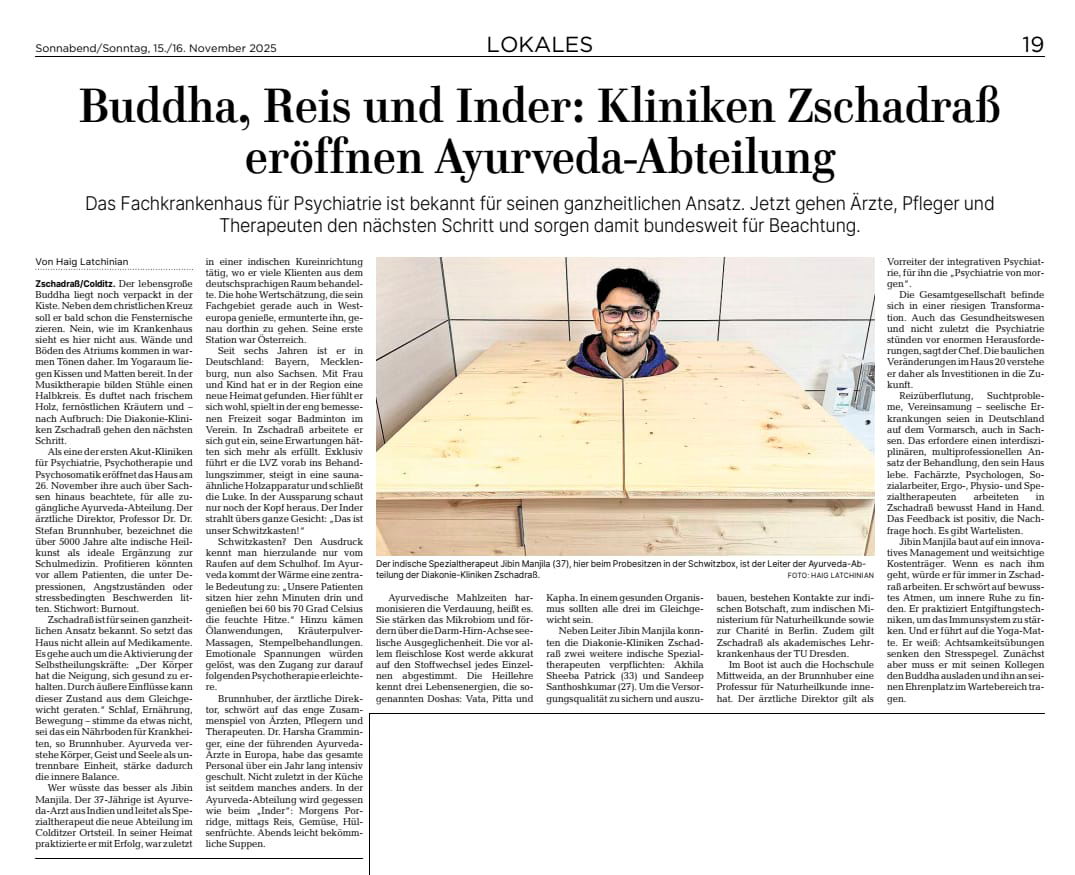
The integration process is currently under way. Initial steps—including staff training, nutritional concepts and internal structures—have been introduced successfully. However, it will take further time before the complete concept is fully established.
True integration takes time. It requires understanding on both sides: among conventional medical professionals as well as Ayurvedic physicians and therapists. This is not about offering an Ayurvedic treatment programme alongside existing care. It is about creating one interconnected therapeutic concept that reaches deeply into everyday clinical practice—while also helping to relieve pressure on the system.
The Change Process: Ayurveda Is Not an Extension, but a Cultural Transformation
Ayurveda cannot simply be added as another department. It requires a fundamental change in thinking, professional practice and collaboration.
This was clear from the beginning: Ayurveda can only become genuinely effective within an integrative system when the entire clinical team is involved—from the medical director, senior physicians and psychologists to physiotherapists, nurses and other healthcare professionals. For this reason, the process was not designed as a top-down project, but as a shared journey reaching every part of the hospital. We held discussions, took concerns seriously, trained together and addressed open questions.
The path was not always easy. There was resistance and scepticism, as well as structural obstacles. Ayurveda introduces a different language, different perspectives and different rhythms. This requires a willingness to embrace change at every level. Through consistent communication, transparency and a shared desire for relief and new therapeutic perspectives, mutual understanding gradually began to grow.
Today, many staff members are looking forward to the gradual introduction of Ayurveda Integrative. They recognise that it is not a foreign element within the system, but a new opportunity to support patients more effectively, holistically and compassionately.
Implementation: Collaboration Instead of Competition
As is so often the case, communication was the key to progress. I did not begin with theoretical concepts, but with conversations—with nurses, psychiatrists, psychologists, social workers and kitchen staff. I listened. I explained. I connected different worlds.
Ayurveda does not demand that an entire system be overturned. It first requires an understanding of:
The interaction between body, mind and digestion
The importance of supporting metabolism within psychiatric treatment
The influence of nutrition on emotional and cognitive balance
The greatest obstacles were not found in theory, but in everyday routines: mealtimes, established procedures and staffing structures.Together, however, we found solutions—small adjustments capable of making a meaningful difference.
The Core: Nutrition and Panchakarma as a Path towards Mental Clarity
The concept developed for Zschadraß is based on two central pillars:
Ayurvedic nutrition, adapted to each patient’s constitution and medication
Shodana therapies, including selected Panchakarma procedures, used in a targeted and medically responsible way
Panchakarma, Ayurveda’s classical system of cleansing and restorative therapies, can play an important role in supporting sustainable change. These treatments are not wellness procedures. They are structured Ayurvedic therapies that must be selected carefully and carried out under qualified professional supervision.
Their purpose is to reduce metabolic burden, strengthen digestive and metabolic capacity—known in Ayurveda as Agni—and support greater physical and mental clarity. This clarity can create more favourable conditions for psychotherapeutic work. When patients feel more physically stable, mentally present and connected with themselves, they may be better able to engage in deeper therapeutic processes. Within a carefully monitored integrative treatment plan, this approach may also support the responsible adjustment of medication and contribute to more efficient treatment pathways.
Any changes to medication remain the responsibility of the treating medical team.
The Potential Impact: Tangible, Measurable and Sustainable
The aim is not only to improve how patients feel. An integrative approach can also influence the atmosphere of the ward, professional attitudes and interdisciplinary collaboration.
Relevant outcomes to observe and evaluate include:
Fewer treatment-related side effects through appropriate nutrition and carefully selected Ayurvedic therapies
Greater stability and responsiveness during psychotherapeutic interventions
Improved self-awareness and a stronger connection with one’s own body and emotions
Potential economic benefits through more efficient treatment pathways, shorter hospital stays and the responsible use of medication
However, none of this can be achieved through Ayurveda alone—or through an isolated Ayurvedic programme. It requires genuine integration: conventional medical expertise working together with Ayurvedic knowledge and clinical experience, structurally embedded and practised across disciplines.
The Vision: Interdisciplinary Care in Practice
This project demonstrates what can become possible when Ayurveda is understood not as an alternative to conventional medicine, but as an intelligent complement to it.
My guiding principle is clear:
Modern medicine leads—Ayurveda is lived.
This is how genuine integration develops: responsibly, evidence-informed and grounded in clinical practice. I bring the experience needed to guide such processes with care, realism and a clear focus on solutions. This includes sensitivity to the realities of everyday hospital life, a deep understanding of both medical systems and close attention to the many details involved in meaningful organisational change.
One Project—Many People Making It Possible
What is taking place in Zschadraß is not the achievement of one person. This project depends on collaboration and on people who have the courage to explore new paths. Without the vision and professional depth of Prof. Dr. Dr. Stefan Brunnhuber, the hospital’s medical director, this integrative approach would not have been possible. His interdisciplinary perspective and profound understanding of transformation within healthcare make him a central driving force behind this new approach to psychiatry.
The open and supportive attitude of the hospital’s management has been equally important—particularly that of Andreas Weigel, who helped create the structural and organisational conditions required for Ayurveda to move beyond an idea and become part of clinical practice.
Roberto Schimana, Executive Board Member of Diakoniestiftung Sachsen, has also demonstrated what responsible leadership can look like. Through his openness and willingness to explore and facilitate new concepts, he has supported an approach that is innovative, compassionate and focused on the future.
Without these individuals—their attitude, trust and openness—the project in Zschadraß would not have been possible.
I am grateful to work with people who do not simply manage the healthcare system, but actively want to shape its future.
Thank You
I am deeply grateful to have been part of this process—grateful for the trust placed in me and convinced that Zschadraß can become a model for the future of psychiatric care:
Integrative, compassionate, medically responsible—and sustained by genuine collaboration.
Ayurveda and modern psychiatry are not a contradiction.
Together, they can create a bridge towards a new understanding of healing.
Would You Like to Introduce Ayurveda Integrative into Your Hospital?

I support hospital teams in developing a responsible, evidence-informed integration of Ayurveda—adapted to the structures, needs and resources of each institution.
Whether you are considering a pilot project, a staff training programme, strategic process consulting or the structural integration of Ayurveda, I can support you throughout the implementation process.
Let us explore new pathways together. I look forward to hearing from you.
Dr. Harsha Gramminger
+49 (0) 172 24 30 880
The time for holistic psychiatric care is now.
Read “Ayurveda & Health Tourism”

Interview
lesen >